Car accident in Spain: what to do and how to fill in the form step by step, from the roadside to our office
In the UK you swap details, take a few photos and ring your insurer. In Spain there is one more step, and it matters: a two-page form both drivers fill in and sign at the scene, the 'parte amistoso'. Here is what to do, in order, the form explained box by box, and two things most newcomers get wrong: which insurer you report to, and who pays the hospital.
The first few minutes: safety before paperwork
The form can wait ten minutes. A second collision cannot. Before you think about insurance, this is the order:
- Stop and make yourself safeIf the cars can move and nobody is hurt, get them out of the lane. Hazard lights on, and put on your hi-vis vest before stepping out. To mark a car that cannot move, Spain now requires a connected V-16 beacon: since 1 January 2026 it is the only valid device, and warning triangles no longer count.
- If anyone is injured, call 112Do not move injured people unless they are in danger where they are. With injuries, even minor ones, the Policía Local or Guardia Civil must attend and will write up an official report, the 'atestado'.
- Call the police too if something feels wrongIf the other driver will not give their details, has no insurance, drives off, seems to have been drinking, or you cannot agree on what happened. Do not argue at the roadside: the police report settles it better.
- Photograph everythingPosition of the cars, damage to both, number plates, road signs, traffic lights and the surroundings. Ask any witnesses for their name and phone number: an independent witness is gold if there is a dispute later.
- Photograph the other driver's documentsDriving licence, vehicle registration document and, if they have it, the insurance receipt or policy. Faster and more reliable than copying by hand with your hands shaking.
- If the car will not drive, call your insurer's breakdown lineRoadside assistance is usually included in Spanish policies. The number is in your insurer's app and your policy documents. If you cannot find it, call us and we will give it to you.
How to fill in the accident form, box by box
The 'parte amistoso', officially the declaración amistosa de accidente, is the Spanish version of the European Accident Statement: two carbonless pages with fifteen numbered boxes. You fill in one form per collision between two vehicles; with three cars, one form per pair. And this is the point that worries British drivers most: signing it is not an admission of liability. It records who was in each car and what happened; the insurers decide fault afterwards from what it says. In Spain, refusing to fill one in looks odd, not careful.
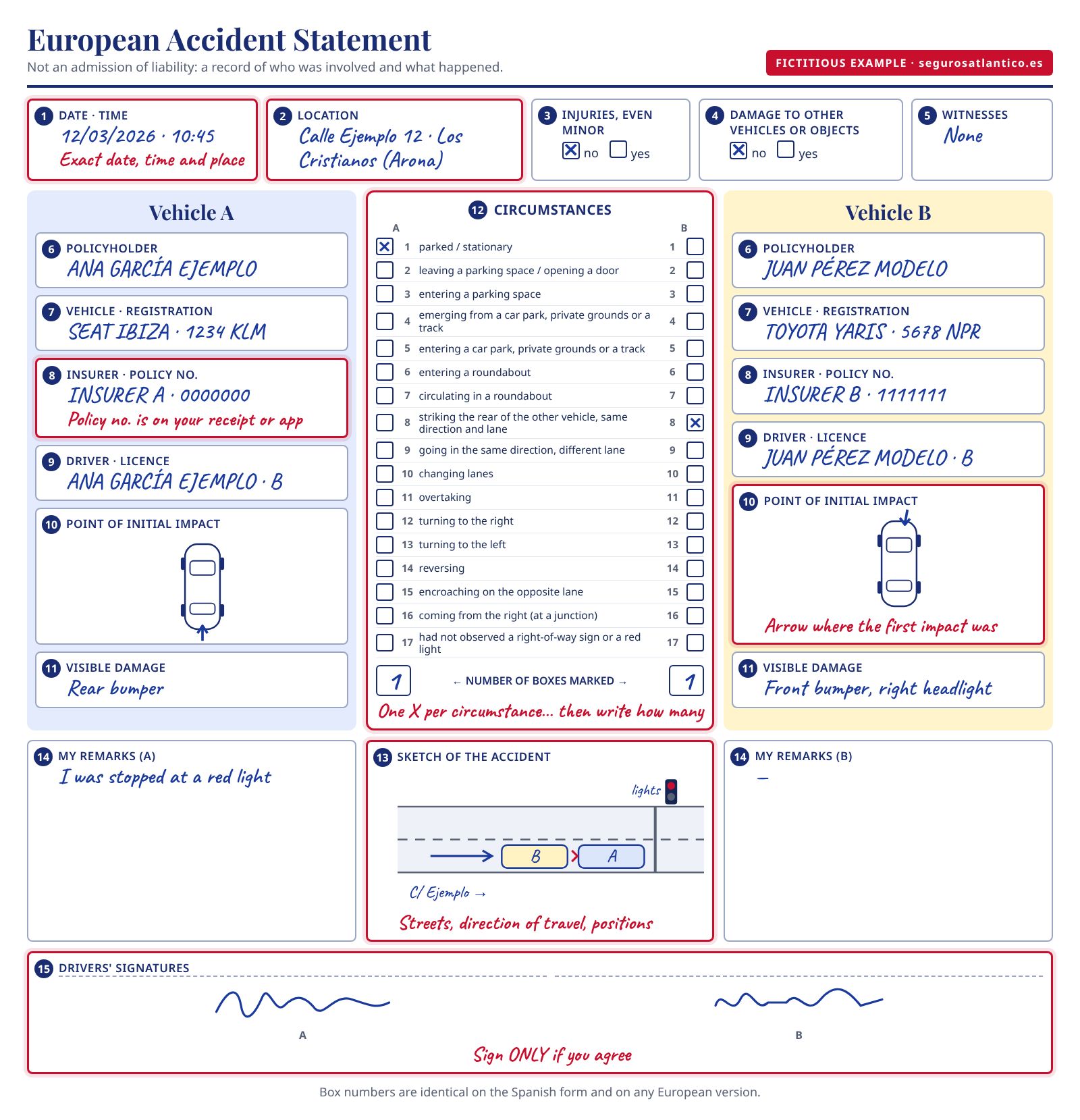
Here is a filled-in example with made-up details: car A was stopped at a red light and car B hit it from behind. In red, the bits people most often forget or get wrong.
- Boxes 1 to 5: when, where and who else
- Exact date and time. Location with street name and number, or road and kilometre marker: 'Los Cristianos' is not enough. Tick whether anyone was injured, even slightly, and whether other vehicles or objects were damaged (a lamp post, a wall). Witnesses: name and phone number.
- Boxes 6 to 9: details of each car
- Each driver fills in their own column, A or B: policyholder, make, model and registration, insurer and policy number, and the driver's details with their licence. Copy them from the documents, not from memory. If someone other than the policyholder was driving, this is where it shows.
- Boxes 10 and 11: where you were hit
- On the car outline, an arrow at the point of first impact. Under visible damage, only what you can see; anything that turns up in the garage later is assessed by the loss adjuster.
- Box 12: circumstances
- Seventeen situations, each with a box for A and a box for B. Each driver crosses their own and, at the bottom, writes the number of boxes marked. That number is what stops anyone adding a cross after signing: do not skip it.
- Box 13: the sketch
- A simple drawing: street names, direction of travel with arrows, position of A and B at the moment of impact, signs and traffic lights. It does not need to be pretty, it needs to be clear.
- Box 14: your remarks
- Your version in your own words. You can write in English. If anything on the form does not sit right with you, put it here before signing.
- Box 15: signatures
- Both drivers sign, and each keeps one of the two pages. Once signed it cannot be changed: if something is not true or you do not agree, do not sign.
If the other driver will not sign
Do not push, and above all do not sign something different from what happened just to make the problem go away. Note their number plate, take photos, find witnesses and call the police. A claim can still be opened without a signed form; it takes longer, but it can be done.
If the other car is foreign-registered or a hire car
In the south of Tenerife this is almost the norm. Because the form is the same European model with the same box numbers in every language, you can fill in the Spanish one and a German or Dutch driver can follow it with theirs. Hire cars usually carry a form in the glovebox and the insurance details on the rental agreement. With a foreign car, we track down its insurer's representative in Spain for you.
Report it to your own insurer, not the other driver's
It is the mistake we see most: 'it wasn't my fault, so I'll go to their insurer'. No. In Spain every driver reports the accident to their own insurer, at fault or not, and you do not need a claims company to do it for you.
This works through a set of agreements between insurers, called CIDE, run through a shared clearing centre, CICOS. When both drivers have signed the form, your own insurer assesses and pays for the damage to your car, then settles up with the at-fault driver's insurer. You do not have to chase anyone. Go straight to the other insurer and you will most likely be sent back to yours, a few days later.
The legal deadline to report it is seven days from the accident, under Article 16 of Spain's Insurance Contract Act. Our advice: report it the same day or the next. The sooner the claim is open, the sooner the loss adjuster comes and the sooner you have your car back.
If you are insured with us, we handle this for you
That is what the office is for. At Agencia de Seguros Atlántico there are three of us, Abigail, Marco and me, and we handle our clients' claims ourselves, from start to finish, in English if you prefer. We do not send you to a call centre or an online form: the best thing is to come to the office in Los Cristianos with the form. With everything in hand, opening the claim takes us about ten minutes.
- You bring the formYour copy, the photos and the police report if there was one. If anything is missing, we tell you what and how to get it.
- We open the claim on the spotWe register it with the insurer and you leave the office with your claim number.
- Assessment and repairsWe explain how the loss assessment works and which garages you can use under your policy.
- We follow it until it is resolvedIf the claim gets complicated, if the other driver has to be pursued, or if there are injuries, we help you with the paperwork until it is properly settled.
Anywhere can sell you a policy. We make sure you are actually insured, and the day you have a crash is when you notice the difference.
If you are hurt: who pays for treatment
This is where most people assume something that is not quite true. 'I've got private health insurance' or 'that's what the public health system is for' are the two answers we hear most, and after a road accident neither covers you the way you think.
- Public hospitals treat you, but do not pay
- A&E will always treat you, whether you are covered by Spanish social security or an S1. But the cost of treatment after a road accident is not borne by the public system: it is billed to the insurer of the vehicle responsible.
- Your health insurance usually does not either
- Most private health policies exclude treatment arising from road accidents, precisely because the car insurance is meant to pay. Look for it in the exclusions section of your policy. The same goes for travel insurance.
- If the other driver was at fault
- Your treatment is paid by the at-fault vehicle's insurer, under its compulsory cover.
- If you were at fault, or you go off the road on your own
- Compulsory insurance covers other people, not the driver who causes the accident. Your own injuries are only covered by one specific cover: driver cover, 'seguro del conductor'. Without it, the hospital bill can end up with you.
Driver cover: the one we recommend most
It covers the injuries of whoever is driving, at fault or not. One night in hospital, a knee operation or three months of physiotherapy add up to far more than people expect. That is why, in the policies we arrange at the office, driver cover comes with a €40,000 limit for medical treatment, which can be raised up to €250,000.
If you are a client and do not know whether you have it, or with what limit, send us your registration on WhatsApp and we will tell you. If your policy is with another company, bring it in and we will go through it with you.
This article is general information about what to do after a road accident in Spain and is not legal advice. In each case your policy wording and current law prevail. The example form uses made-up details. As an exclusive agent we work with the products of a single insurer; the deadlines and agreements mentioned apply to any insurer operating in Spain.